Marine ich and velvet in marine fish
Cryptocaryon and Amyloodinium are the most feared parasites in saltwater. How to recognise them, how their life cycle works, and how to tackle them without harming your corals.
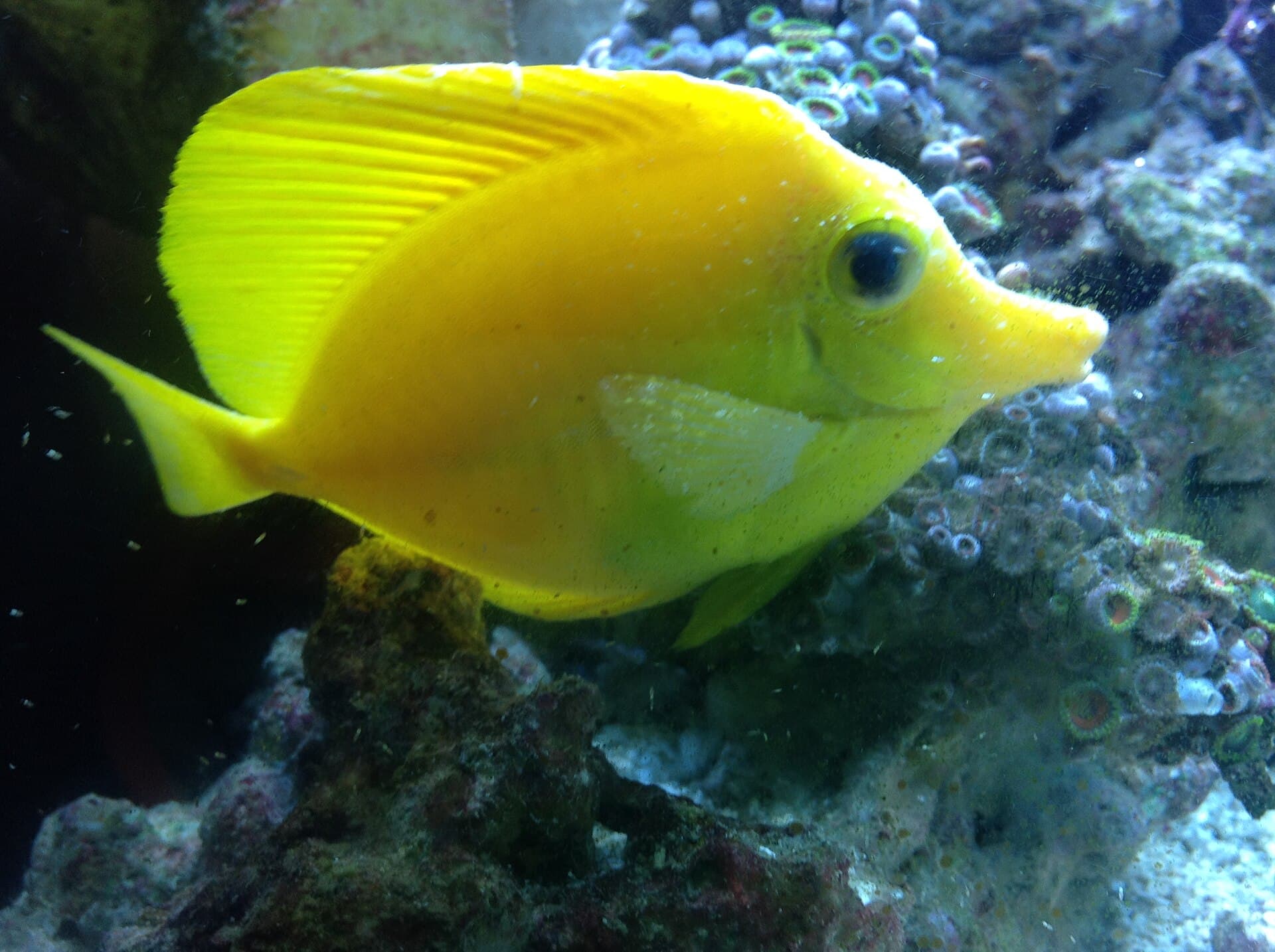

Marine ich and velvet are the two parasitic diseases marine keepers fear most. They are often introduced with a new fish and can spread extremely fast. If you understand their life cycle, you can fight them effectively.
Marine ich (Cryptocaryon irritans)
Symptoms
- White dots, like grains of salt, on skin and fins.
- Flashing against rocks and sand.
- Rapid breathing, reduced appetite.
- The spots sometimes disappear for a few days and then return, often in greater numbers.
The life cycle
- On the fish: the parasite feeds in the skin or gills for a few days. These are the visible white spots.
- On the bottom: it drops off and forms a cyst on rocks or sand. Inside, it divides into hundreds of new parasites. This stage usually lasts a few days, but sometimes weeks.
- In the water: the new parasites swim freely and look for a fish within a short time. If they don’t find one, they die.
That’s why a treatment on the fish only works if it lasts long enough to catch every stage, and why ‘the spots are gone’ is no proof that the parasite is gone.
Velvet (Amyloodinium ocellatum)
Symptoms
- A fine, dusty, gold or grey coating on the skin, often best seen in light falling at an angle.
- Very rapid breathing, sometimes with an open mouth.
- Fish hanging at the surface or in the flow, no longer eating.
- Deaths within a few days, sometimes of several fish at once.
Velvet is much faster than ich. If in doubt, act immediately.
Approach
Always treat all fish in a separate treatment tank, never in the reef aquarium: the usual treatments are deadly to corals and invertebrates. Methods used are:
- Copper: the most widely used treatment. It requires accurate measurement with a copper test, and not every fish tolerates it equally well.
- Chloroquine phosphate: often used against velvet, but prescription-only in many countries.
- Tank transfer method: the fish are moved into a clean tank several times, every few days, so that parasites dropping off the fish are left behind.
- Hyposalinity (a strongly reduced salinity): works against ich, but not reliably against velvet. Lower it slowly and measure with an accurate refractometer.
Yawar deliberately gives no dosages: always follow the product’s instructions and, when in doubt, ask a vet experienced with fish. Always treat fish in a separate tank, never in the reef aquarium.
Making the reef aquarium parasite-free
While the fish are in the treatment tank, the reef aquarium stays fishless. Parasites that don’t find a fish die. That’s why many keepers leave the aquarium fishless for around ten to eleven weeks. Corals and invertebrates can stay, because the parasites only use fish as hosts.
Prevention
- Quarantine every new fish for four to six weeks.
- Don’t pour water from the shop bag into your aquarium.
- Be careful with new corals and invertebrates: their water can also contain free-swimming parasites or cysts.
- Stable temperature and good water quality, so your fish’s resistance stays high.