The best plants for a discus aquarium
Not every aquarium plant tolerates 29 °C. These plants do well with discus, and here is how to combine a beautifully planted tank with healthy fish.
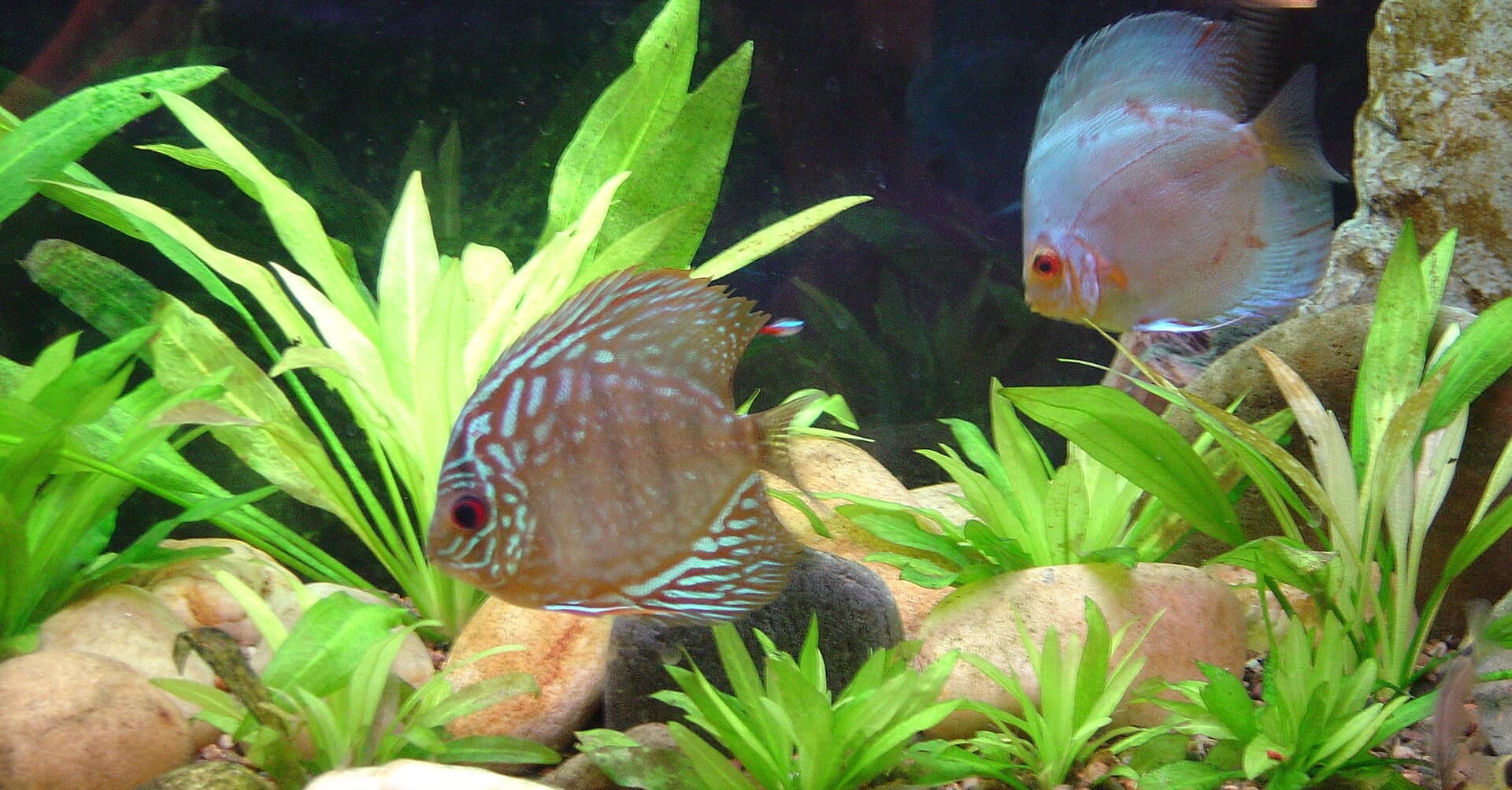

A planted discus aquarium is beautiful, but not every plant copes with 28–30 °C. Many popular plants grow too fast at that temperature, become leggy or slowly die off. So choose plants that tolerate warmth well.
Large specimen plants
- Echinodorus (Amazon sword plants): the classic, from the same region as the discus. Large leaves offer calm and shelter. Give them root tabs.
- Vallisneria: long, ribbon-like leaves for the background; grows well in warm water.
Plants on wood and stone
- Anubias: tough, slow-growing and almost indestructible. Tie them to wood instead of planting them.
- Java fern (Microsorum pteropus): also an epiphyte, tolerates low light and high temperatures.
- Bucephalandra: small, graceful plants for wood and stone.
Foreground and midground
- Cryptocoryne: C. wendtii and C. balansae among others do well with warmth and low light. They are sensitive to large changes (‘crypt melt’), but usually grow back.
- Helanthium tenellum (dwarf sword): a low carpeting plant, if there is enough light.
Floating plants
Floating plants such as Limnobium (frogbit) or Salvinia dim the light, which discus like, and absorb nitrate. Make sure they don’t cover the entire surface and leave an area free for gas exchange.
Better avoided
Many plants from temperate regions and fast stem plants (for example most Rotala and Ludwigia species) struggle at this temperature without lots of light and CO₂. Cabomba usually does poorly too.
Tips for a planted discus tank
- Keep a large open swimming area in the middle.
- Plant densely at the back and sides, not everywhere.
- Choose a sand substrate with root tabs, so you can easily siphon off waste.
- Don’t let food lie between the plants: rotting food is a major source of nitrate.
- Discus don’t eat plants, but large water changes with soft water can cause deficiencies. An iron-rich plant fertiliser helps.